Saturday, June 22, 2019

Some Type II Fun on the First Day of Summer


It's Summer!!!!!


Very recently, I came upon an organizational tool called The Fun Scale.  Those of you who don't live your lives melded to a series of lists, who don't have short, medium and long term goals, who don't get up to an alarm even after you retire:  Not For You.  For those of us who even like to quantify our Fun:  You Gotta Love It! 

Apparently developed by outdoor enthusiasts, I'll share this description from www.rei.com/blog/climb/fun-scale: 

"Type I Fun:  Enjoyable while it's happening.  Also known as, simply, fun."

Example:  A hike of reasonable length on a sunny but not too hot day in a glorious location with a enjoyable companion of like mind.

"Type II Fun:  Miserable while it's happening, but fun in retrospect.  It usually begins with the best intentions, and then things get carried away."

Example:  Walking Snowbowl Road for America Cancer Society's Climb to Conquer Cancer.  Seven miles of 6% grade with no relief.  But afterwards:  free food, music and massage!  Feel good for supporting a great cause!  Feel good for actually finishing!  Brag to friends and family that you did it!

"Type III Fun:  ...not fun at all.  Even in retrospect.  Afterward you think, "What in the hell was I doing?  If I ever come up with another idea that stupid, somebody slap some sense into me." 

Examples:  Deciding to hike in the mountains on a summer day with a 75% chance of a monsoon rain.  It pours rain and includes some way-too-close-lightning and thunder and a mad dash to the too-far-away-car through a very exposed area.

Though this scale is often used to outdoor activities, it's flexible enough to apply to just about any activity you feel the need to quantify this way.  Have Fun with it!  

Which leads me to my Type II Fun activity today:  The Fourth One-Woman Sprint Tri.

I've done three of these since I retired.  Then a couple of frustrating years of injuries.  This year,

I'M BAAAAACK!  

Triathlons are typically organized with swimming first, followed by biking, and finishing with running.  Swimming comes first when the participant is freshest.  The concern with having it last is the participant's exhaustion grows with each event, and exhaustion during swimming, especially open water swimming, can lead to drowning.  Type IV Fun???

However, since I'm in charge of this event and its only participant, I chose this year to bike first, then run, and swim last.  One reason was to get the outdoor stages complete before it got too hot.  As it happened, I checked the weather Thursday night and saw it was a wind advisory day, and that was another good reason.  Next, I wanted Ron to take pictures at the pool.  He goes to town a little later in the mornings on Fridays, and I wanted my pool time to coincide with a time he was already in town.  Finally, I wanted to try the swim last to see if it would help my legs recover from the bike & run stages.

I did stick to the official distances of a sprint tri.  

The Fun started at 7:05 A.M. with the 12 mile bike ride:


 followed by the 5k run:


and ending with the 1/2 mile swim:


What a fantastic Sprint Tri!  The best one yet!  I had planned for Thursday to be a rest day; as it worked out Wednesday was a rest day too. I believe the extra rest day really helped make this a strong event.  I also really liked swimming last.  It did as I hoped, helped my legs recover by not having to work as hard and being in the water.  I had thought about hopping in the hot tub for a bit after my swim to soak some for recovery.   However, I was still quite flushed when I went in the pool, and I know that for me swimming tends to bring blood to the surface.  I didn't feel comfortable pulling even more blood away from my heart in the hot tub, so I passed.

At home, I celebrated with a Mediterranean Pizza from my favorite joint, Papa Murphy's.  And reading "Between a Rock and a Hard Place."  Remember some years ago the guy whose arm got caught by a rock in a slot canyon and he had to cut it off?  Yeah, that one. Type III Fun all right.

Why this was Type II Fun:  This year, it was actually Type I Fun while I was doing it; not a miserable moment.  It's also Fun in retrospect.  What made it Type II was the difficulty-yes, it was hard!- and the recovery.  Though I finished strongly, I could feel my mental capabilities waning rapidly when I got out of the pool, and I'm still feeling the effects both mentally and physically today.  However, it was definitely enough Fun to do again next year.  Until then:


Thursday, June 20, 2019

An Olympic-Sized Park, Part III: The Temperate Rain Forest


We were in and out of rain forests throughout our trip.  Our first taste was the Elwha Valley, and we were properly awed.   At the time, we thought these trees were large and moss covered, and they were.  We were but babes in the woods!  


We saw the first of several waterfalls here.

Madison Falls

 This was another poetry walk.  I'm so glad people think like this, and write it down to share! 


 Sol Duc Valley was our second taste, and here we began to see the true nature of the rain forest.


This is what's called a nurse log.  A tree falls down, for whatever reason.  Very soon, all sorts of vegetation pulls up a chair at the table and feasts.  This nurse log has a row of saplings growing upon it.  Over time some will die out and others will live.  Their roots will wrap around the nurse log to the ground.  Forever.  When the nurse log finally deteriorates completely, which can take hundreds of years, the roots stay in the position they originally grew.  Crazy!!!

Another nurse log.  Life and death are inseparable here in a whole different way.  


This would be a nurse stump. 


This is a close-up of a living tree branch.  The ferns and mosses are not parasitic here.  They get their nutrients from rain and ambient moisture.  We're not in Arizona anymore, Toto! 


Sol Duc Falls required crossing over this bridge.  Ron can't help being a nut, taking a picture of me taking a picture of him!


Sol Duc Falls


The Hoh Rain Forest was outstanding!  Fantastic trees and mosses. 


Because there is so much moisture, roots are shallow.  When a tree goes down, the root ball comes right up. 


We took a loop drive around Lake Quinault in the Quinault Rain Forest. 

A view of Lake Quinault


It was more open here, but open is relative to a base-line density which is VERY DENSE!


Ron looking up again.  We all did! 

Scott is just under 6' tall.  This ordinary-sized log was cut to keep the trail clear.


Water, water everywhere.

Merriman Falls
Human influences can be temporary:   


We took the Maple Glen trail to the historic Kestner Homestead.  It's currently being renovated, and had too much of a modern appearance to catch my interest, though the property was originally homesteaded in 1891.  This Chevy truck made a good picture.


In a land of natural wonders, we happened upon a couple more.  According to www.portangeles.com, the Olympic Peninsula is the home to "the highest number of gargantuan trees contained into the smallest area in the whole wide world".  Eight of them are identified for tourism purposes; only two of those are easily accessible.  We saw those two:

The World's Largest Spruce Tree


The World's Largest Red Cedar Tree


A human perspective: 


  Well, I guess this story is told.  Once again, we were reminded of the privilege of living in a country that not only has such a place to visit, but that it's readily available to all of us.  I leave you with this look at the Maple Glen trail:


Monday, June 17, 2019

An Olympic-Sized Park, Part II: The Beaches


This is the way the beach looks and sounds on the Olympic Peninsula.  My first impression, which did not change was:  the Pacific isn't very pacific here!  Yes, it's the same Pacific we experienced in Hawaii.  But Hawaii looked like this: 


Hawaii:  same Pacific, but very different!    


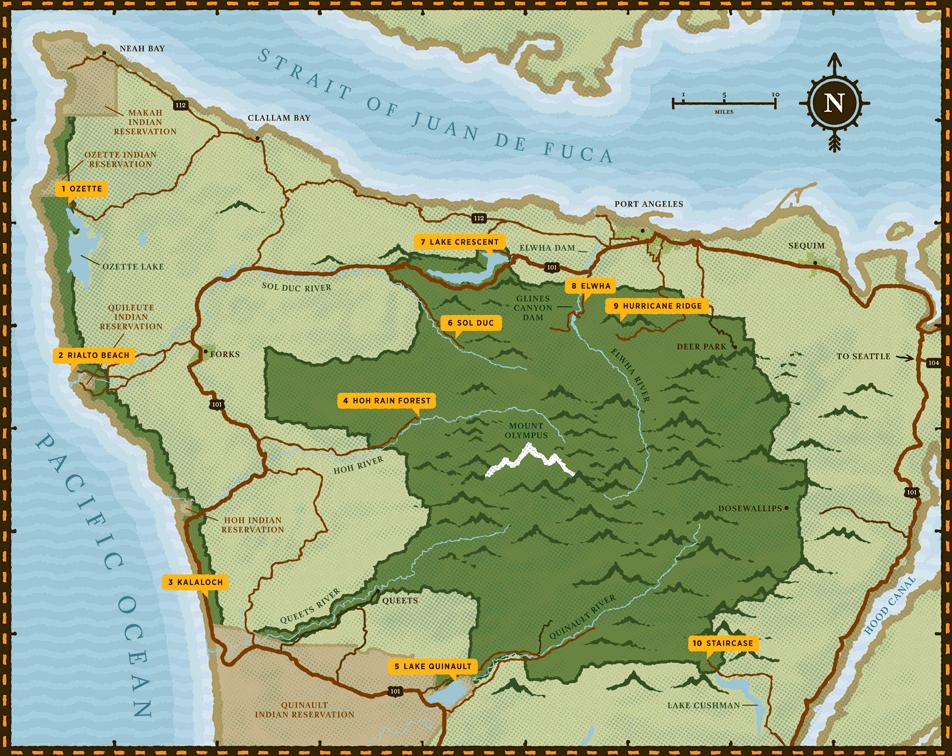
Here's another map of the Olympic National Park.  The large dark green area in the center is the main part of the Park.  However, see that strip of green along the coast?  Yep, that's where the beaches are. Same Park, separate area entirely. 


Image result for olympic national park beaches map


It won't surprise you to know that Native Americans were on the Olympic Peninsula first and got "treatied" out of the majority of their land in the usual way.  There remain remnants of the fishing tribes all along the shore area of the Park, and the Park maintains a relationship with them that includes recognition of their traditional lands and practices. 

The first beach we went to, named Second Beach, is part of the Quileute reservation.  The video above is from Second Beach.  This photo is of The Arch, for which the beach is well known.


Ron and I had our first-ever experience with tide pools here.  Scott lived in Los Angeles for many years and spent plenty of time on the beach, so he was able to open our eyes to the life we didn't even know to look for.
 
Sea anemones were fascinating and colorful:


All the starfish we saw were this color:


The rocks were alive with who-knows-what:


This entire rock was encrusted with layers and layers of life. 


There were lots of little crabs, but they were too quick for my camera.

The next beach we visited was Rialto Beach, also part of the Quinault reservation.  One of the notable qualities of all the beaches was that the drift wood was more properly called drift logs.  Because the coast abuts the forest, the trees that fall are taken by the tide.  They become a formidable barrier like this, and visitors are warned about the need to know the high and low tide times.  During high tide, the logs become a moving cauldron, with the ability to catch and kill the unwary.


Rialto Beach.  The haze was typical at all the beaches we visited.  They were also chilly and windy.  These were NOT bikini beaches!


Ruby Beach too is part of the Quinault Reservation.  It didn't hurt our feelings to have to access the beach via this trail:


A view of Ruby Beach from the trail.   You can see the piled up drift logs. 


This view, as well as others you've seen, includes an island-looking formation that is called a sea stack.  Sea stacks are formed through erosion.  First a cave forms.  When the cave washes through, an arch is left.  When the arch collapses, the remaining formation is the sea stack. 


Ron and Scott are making their way to the beach through the jackstraws.


Kalaloch Beach is also part of the Quinault Reservation.  The sand is of a lighter color.


More tide pools here, with different life forms.


An iconic feature of this beach is variously called the Tree of Life and the Kalaloch Tree. 


It's a Sitka Spruce, hanging on by its roots, with a cave underneath.  If you click on the picture, you'll see Ron sitting in the cave.  It's so named because despite its appearance of imminent collapse, it clings fiercely to life.  No one knows how old it is. 

Having lived a land-locked life and not visited this environment often, the ocean and beaches are mysterious places for me.  Inscrutable, unknowable, magical, mystical, and REALLY BIG! 


Next up:  the Temperate Rain Forest.