Sunday, April 28, 2019

Where In The World???


Image result for globe
Source:  Pixabay


"Where in the World" is my current reading Focus Interest.  As you may recall from previous posts, I sometimes find an area of interest into which I wish to delve deeply.  I find and read as many book as I can about the topic.  So far I've explored Mountain Climbing, the artists Vincent Van Gogh and Mary Cassatt, and the Hinges of History series by Thomas Cahill.  There's no time or number of books criteria.  I'm finished when I'm saturated. 

Some time ago I acquired a new globe (geography doesn't change; boundries do!).  I printed a list of all the countries and for awhile Ron and I spent our dinner time finding every country in the world.  It was fun, and we found some countries we didn't know about. 

A few months ago I was reading a collection of travel essays. The introduction was by a writer and traveler from Britain.  He commented on the difference between European travelers and US travelers. As you might expect, European travelers tend to be much more "worldly"; European countries are geographically the equivalent of US states!  He then made an observation about how younger people are becoming, overall, less knowledgeable about both geographical and political boundaries in the world.  He gave an example of the daughter of friends who attended the United Nations International School in New York (tuition ~$40,000/year) but couldn't find Israel on a globe. 

And that's how this Focus Interest found its Focus.  Having identified all the countries on the globe, I decided I wanted to become more "worldly" by learning a little about each of them, with special attention to those I know least about.  There are 195 countries in the world; plenty of which I know nothing about!  I also chose to start with the smallest geographically and read to the largest.  I love the WWW-that list was at my fingertips.
 
I'm acquiring books on my current favorite used book site, Better World Books.  I have a price criteria of ~$5 or under, and that requires me to be flexible on content.  I've found historical accounts, personal accounts, fiction, and lots and lots of travel guides.  Each is interesting and informative in its own way.  I have gotten caught not looking at a book closely enough before buying and found upon arrival it was a children's book.  But I also found a book that included five teeny tiny European countries in a fell swoop.


Do you know which is the smallest country in the world?  I didn't.  It's the Vatican.  Yep, its own country.  After that, it's islands in a large area of the Pacific, then those teeny tiny countries in Europe called micro states, including the Vatican, then more variously located islands. 

So far my reading has been primarily about island countries.  No matter how small the country, there's a history.  Surprising to me is the number of islands that have been "acquired" for military and political purposes, both by the US and European countries, usually to the detriment of the islands.  Some have struggled and succeeded in regaining autonomy: Tuvalu, Nauru, Palau .  Many are still in  never-never land, neither independent nor fully supported by the country of political control: Puerto Rico, Guam, Philippines.  

My favorite book so far is "Where the Hell is Tuvalu?"  It's a personal account of a young English man who tires of his big-city lawyerly duties in London and volunteers for Voluntary Service Overseas, the UK equivalent of the Peace Corps.  He is assigned a two-year stint as the People's Lawyer on the island of Tuvalu, deep in the Pacific Ocean.  It's the account of his culture shock, his necessary acceptance of climate, living conditions, food, and the ways he could or could not be helpful.  It's well told, with clarity and humor. 


What a journey I'm on!  It's a path of learning I couldn't anticipate. There's a big world out there, and I'm looking forward to continuing this new way of knowing it.




Sunday, April 14, 2019

What's Up For April?


I actually made April Intentions on April 1 and have been practicing them.  With my calendar saying it's already April 14, let me go about sharing!

  • Challenge-of-the-Month: 

This challenge is the start of changing some on-going eating habits that must be modified. On-going meaning years and years.  It's going to be tough, so I'm starting small.  My dinners are large enough to satisfy.  A snack is necessary before bed to get me through the night due to low blood sugar.  Yes, I have a very nice plan for this eating.  The problem arises when I eat between dinner and the bedtime snack.  Any such eating is strictly emotional/mindless/munching/calories I don't need and are showing up in places I don't like! 

CHALLENGE:  EAT NOTHING BETWEEN DINNER AND MY BEDTIME SNACK. NADA. NIX. NOUGHT.  ZIP.  ZILCH.  ZERO. 

Image result for no
Source:  Pixabay   


  • Cooking School:  
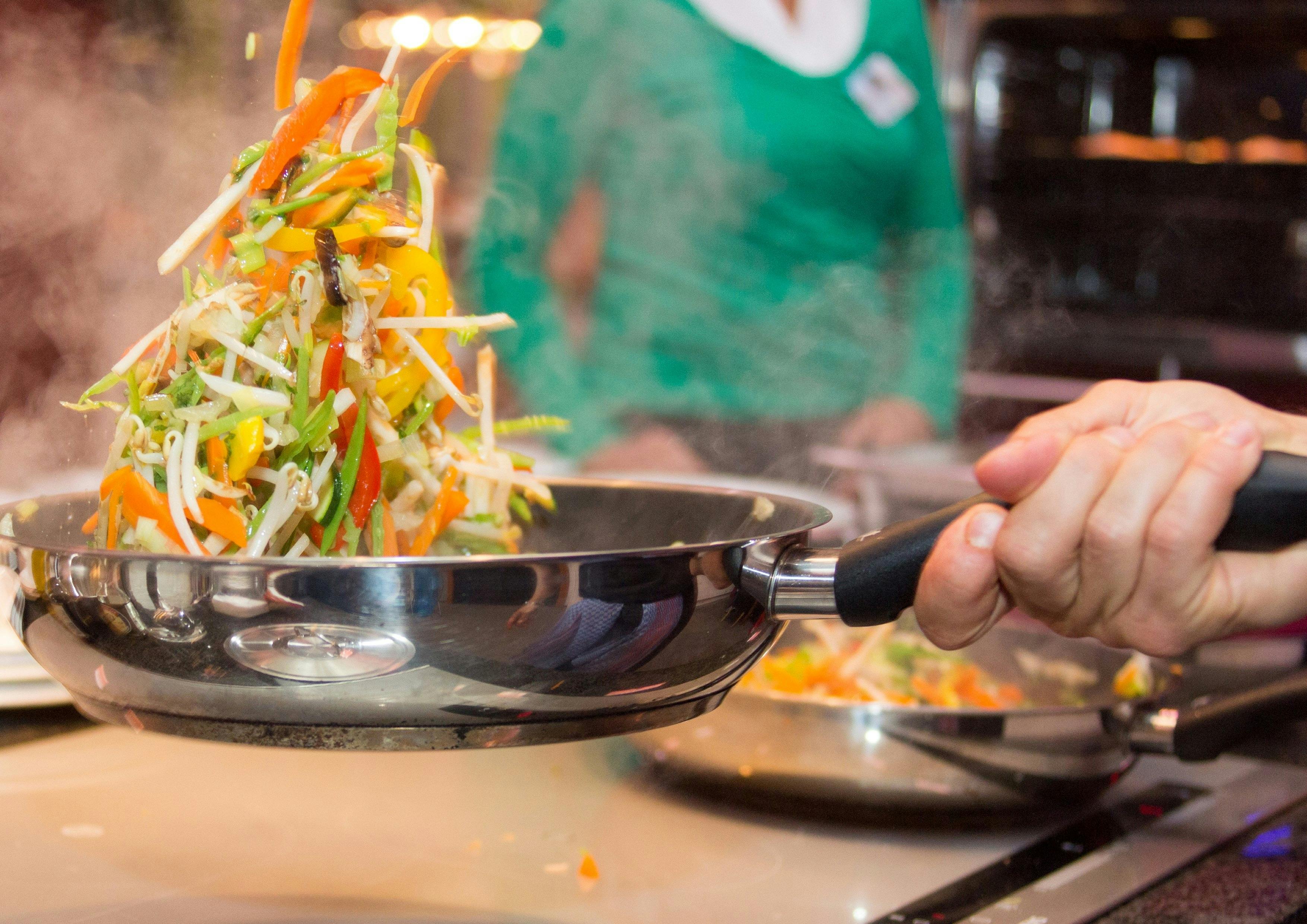
This month's topic is Saute.  A person might ask, as I did, what the difference is between Saute, Fry, and Stir-Fry.  You might rightfully say, not much!  However, there are some subtle differences.  According to G. Stephen Jones at www.reluctantgourmet.com, the difference between Saute and Fry is the size of the pieces.  Saute is used for veggies, meats, etc. cut into small pieces and cooked over a little higher heat.  Fry is used for larger pieces-chops, chicken breasts, etc. and cooked at a little lower heat.  Stir-Fry is saute in a wok.  Having the definitions straight, I find I need only be a little more conscious of the size of the pieces to achieve this way of cooking.  No, I'm not planning to add that special toss the chefs love, but it looks so cool! 


Image result for saute
Source:  Pexels


  • Buy two housplants.
One of my larger houseplants acquired a sticky, nasty scale in the early winter.  Another is just not doing well.  Any qualms I might have about the demise of houseplants is assuaged by our compost bin.  They're in the great cycle of life!  I wanted to wait until spring to replace them so the new plants would be in their vigorous growth time and adapt more easily to the change in environment.  Spring is now! 

That empty spot in front of the window is for one of the new plants.

  • Change the strings on my violin.
My violin teacher Emily doesn't have a rule about this.  I've said I'm going to change them every-so-often in the past, but don't remember how often that was, or why, or how long ago I changed them.  Though advice on the internet is all over the place, I'm going with this recommendation from D'addario, a well-known maker of strings: "Strings that are installed on an instrument will wear out eventually since they are under tension and exposed to humidity and corrosive pollutants in the air.  Therefore, one should change the strings on an instrument at least every year for violin and viola, and every two years for cello and bass, even if they are not frequently used."   I'm not sure how long it's been since I changed my strings, but I'm thinking 2-3 years.  That makes it more than time!  I checked my violin case and found two new sets of strings so I'm prepared.  I've also added a reminder to a comprehensive list of monthly tasks that are done annually.  I'm quite uncomfortable changing the strings for no reason other than unfamiliarity, and have always asked Emily to do it for me.  This time I'm going to do it myself.  It can't go so wrong it's unfixable.  And I'll bet there's a tutorial on YouTube! 


  • Start bike training for the One-Woman Sprint Tri.
Swimming and running are in place.  The weather has warmed and road conditions are satisfactory to get on the bike.  I'm starting with once a week and will increase over time.  I'm undecided on the date, as we have now scheduled our Spring Vacation at the mid-May time I had in mind.  I'll probably bump it out 'til after we return but still before June 11 when my Aquaplex membership expires.


She's ready to ride!

 
  • Start reviewing Agility training for both Jasmine and I.
 What a smart cookie Jasmine is!  With only a little review, she's getting right back to where we left off.  Me, too.  Yesterday the local agility club sponsored a loosely-organized fun run at their dedicated training field.  We went to get our feet wet.  Loosely organized is a generous description, but I learned a lot.  I had Jasmine on every piece of equipment, all of which was competition size, and she had a blast!  The first time she needed encouragement; after that, I could hardly keep her off.  The training field is about one-half hour from me, which makes it unsuitable for any daily training.  However, there's a really nice park with a baseball field at the front of Kachina Village.  I could go on-line and get ideas for setting up variations of small courses, load the necessary equipment in my van with Jasmine, and go out there once in a while.  Yep, yep.  


  • Make a donation in memory of my parents.   
My parents died in April 2011, and after some trials, have settled on making a donation in their memory each April.  I've donated to the local soup kitchen, to the local free medical clininc, to the Literacy Volunteers.  This year I donated to a program called Gear Girls.  It's an Arizona Trail project sponsored by REI.  Here's the description from www.arizonatrail.org:  

"Gear Girls uses mountain biking, trail work and snow sports to build confidence, outdoor competence, community and character in young women grades 4-8. Girls learn practical skills in trail building, mountain biking, cross country skiing and snowshoeing while absorbing lessons in mindfulness, teamwork, and determination that will prepare them for life’s bigger challenges."

My parents were both avid bicyclists, and spent time working on the Colorado Trail when they lived in Salida.  I think they'd like it.   

Source:  www.azt.org

 
  •  Easter Break in Tucson.
Coming right up!  I leave Wednesday, and will spend a week visiting Family & Friends.  It's gonna be so much fun! 


Sunday, April 7, 2019

My Kitchen is BUSY!!! (Part I)

Small but mighty, this is our kitchen and dining area.


Ron and I have never chosen to do much restaurant eating.  Even the short 20 minutes we live outside of Flagstaff means "going to town", and that's a no-go for us.   Over the years, it's also been an unintentional frugality, as restaurant eating is well-known to take a bite out of the budget. (Groaner!)


Since retirement, my kitchen adventures have changed drastically, for several reasons.  First, I now cook dinners regularly.  For the ~25 years I worked as a dispatcher, most of it on swing shift-2:30-10:30 pm-I wasn't home to make dinners.  I'd cook up batches of grains and meats, throw a serving of those plus some frozen veggies in a container, heat it up at work, and that was my work-dinner for years. I was ready for some variety, and post-retirement dinners reflect that. I'm a decent home cook, well-grounded in midwest styles and flavors, supplemented by years of southwestern living and foods.  With the help of that bottomless resource, the Internet, I've been happy to explore variations on comfortable themes as well as the un-risky stretches I've mentioned here with my Cooking School theme. 

Secondly, several years ago I went to a nutritionist for some digestive issues, and under her supervision, embarked on an eating journey that involves a lot fewer carbohydrates and more fats and protein. This changed proportions but not content.  It also introduced the regular consumption of fermented foods and bone broth for overall gut health and function.

The result of these combined forces is that I do PLENTY of kitchen work.  Part I of this topic shows some of the foods I keep on hand that are specific to my nutritional changes:


Fermented foods: some benefits of fermented foods, as explained on draxe.com:

  • Create protective lining in the intestines.
  • Lead to the creation of antibodies and a stronger immune system.
  • Regulate the appetite and reduce sugar and refined carb cravings.
  • Enhance nutrient content of foods and make minerals more readily available.  
  • Produce vitamins and enzymes beneficial for digestion/gut health.

My first choice of fermented food:

Beet Kvass:  Fermented Beet Juice


3# of organic beets are cut into large pieces and packed into a gallon jar.


Water and salt are added and it's set aside on the counter for its first 3-day ferment.  The same beets can be used for 3 separate ferments, resulting in a quart of kvass per ferment.  I love the color of the kvass!  As you can see, it has variation, with the first ferment usually being lightest.  These quarts of kvass are stored in the refrigerator until used, and have a long shelf life. 


I drink 2 oz of kvass each morning before eating to provide my digestive day with probiotics from the get-go.   The flavor is quite nice, sweet as you might expect, and the ferment gives it a punch.  The 2 oz is plenty.  


My second choice of fermented food:


Fermented Sauerkraut


28 oz of cabbage and carrot combo are thinly sliced & grated.


Salt is added, then this wooden device, variously called a stomper, pounder or tamper, is then applied vigorously to the mix for about 10 minutes.  The fibers are broken down and juices released to stimulate fermentation.


This is the resulting amount, which is packed tightly into a quart jar.


It's set aside on the counter for...awhile.  I've experimented and am currently liking two weeks on the counter, then refrigerating it until it's used.  I use several tablespoons of this per day, either added to other food-salads, soups, sandwiches- or eaten separately.  The flavor is mild and entirely unlike sauerkraut prepared with vinegar.  


Bone broth: some benefits of bone broth, as explained on draxe.com:


  • Treat leaky gut syndrome.
  • Overcome food intolerances and allergies.
  • Improve joint health.
  • Reduce cellulite.
  • Boost immune system.


Chicken or beef bones, preferably organic, are roasted in a slow oven for an hour.  They are then placed in this large pot with salt and pepper, an onion, bay leaves, and the peelings from those beets for color.  The broth is simmered for 48-72 hours.  It does have a distinctive odor, so this is done on a hot plate on the porch with the window cracked.  


The broth is then strained to remove the bones and veggie leavings.  It is stored in two cup servings in these jars in the deep freeze.  The broth has a very mild, pleasant flavor.  I drink one cup per day, usually as my bedtime snack, heated with cheese, quinoa and often some sauerkraut, and it gets me through the night nicely.